Deconstructivism
Deconstructivism in architecture can be explained simply as the process of dismantling an existing building and rebuilding it differently to convey new meaning through this reconstruction. Deconstructivist architects perceive it as the process of breaking down the modern conservative foundation of architecture to birth a new footing for design and creation.
This concept spurred my interest and as I researched more into it, I came across the philosophies behind this movement. It was a rebellion against established norms, a bid to correct the existing structure by destroying and creating. These architects “locate inherent dilemmas within buildings” and through a process of dismantling and rebuilding correct these flaws and convey new meaning through this creation. However, the core issue is that it is the foundation of these existing systems (modern conservative architecture) that birthed these issues. Therefore, modern architecture is inherently flawed. I’d liken this to punk culture in that rejection of tradition is favoured to advocate for personal freedom and autonomy. To achieve growth, one must examine the foundation of every structure.
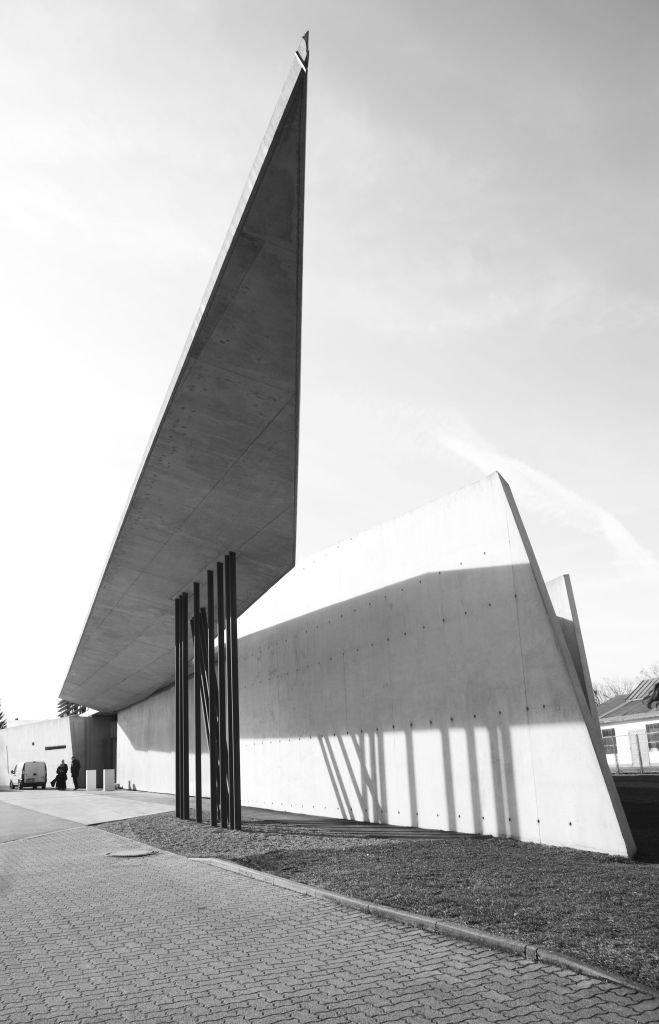
This theory as rooted in architecture as it is did not originate in this discipline. It first came to light through the ideas of Jacques Derrida in the late 1960s/early 1970s, this Algerian French philosopher proposes that the perception with which we view concepts is based on established traditions. The way I perceive “beauty” living in the West would largely be predetermined as the established definitions of Western beauty have been dictated long ago, e.g., small lips, blue eyes, blonde hair, etc. He then goes on to state that these existing notions are inherently flawed and there are no absolute truths, our understanding of truth, meaning, and reality is shaped by language, culture, and history, therefore, it is always subject to revision and reinterpretation. Only by questioning the binary can we understand the complexities of the world and its issues, and only through critical analysis of our assumptions about truth and knowledge can we realize its limitations and contradictions inherent in any system of thought or belief. As a result, a reorganization of existing perceptions is paramount.
This thought process would eventually trickle down into a multitude of disciplines as it became culturally and socially significant. Mainly art, politics and architecture employ these basic tenets though modified according to discipline.
The traditional architect’s goal has always been stability and order through pure form, the form found in simple geometric shapes In this symphony, no movement can intersect or distort the other. However, in my perspective and I presume the perspective of deconstructionist architects, the impurity lies in the perfection of form. In a bid to attain “perfection”, countless paths to creation are destroyed. This is death through singularity.
Crust Punk
A movement originating in the late 1970s and early 1980s in the UK as a subgenre of punk rock, it embodied themes of punk in its rebellious nature, anti-establishment ideology and anti-capitalist ties. “Crust” as used more commonly by participants of a now worldwide subculture (ironic isn’t it) philosophies embodies anarchism, a disregard for all forms of hierarchical authority, with a DIY spirit and hatred for capitalism. Their beliefs stem from a subversion of the mainstream, and like deconstructionism, understand that innovation and radical thought are the only solutions to our flawed system. Crust punk is a platform for marginalized voices to express disapproval, resound awareness about social issues, and envision alternatives to dominant power structures.
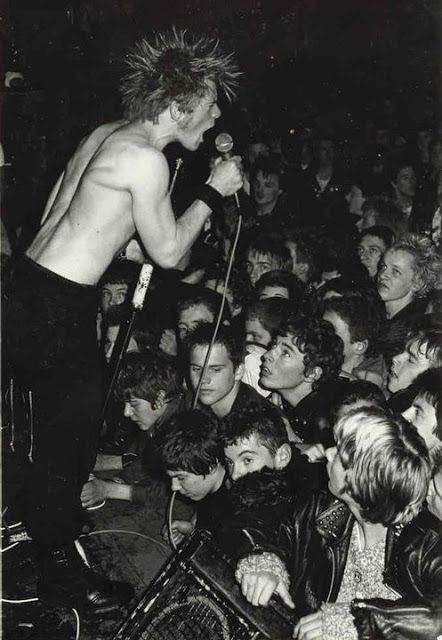
Now, crust punk fashion like the subculture has its origins in the UK, seen in bands like Amebix, Discharge, Crass, Hell Bastard and Nausea all known to be influential in shaping the early style and culture. However, it is important to note that crust punk, like punk did adopt various cultural symbols and items from various ethnic groups and marginalized groups into their style, though I cannot say for absolute if it was an adoption or an appropriation, these cultures such as reggae and Rastafarian could be reflected in crust punks adoption of dreadlocks, Latino and Chicano culture with Mexican inspired embroidery/design, pacific islander prints, largely African prints, etc. Though to my understanding, a lot of this incorporation was in large part due to the varied marginalized groups from these cultures adopting punk and the relation between punk and said groups.
Crust punk pants, a staple of crust punk culture were birthed from a desire to maintain one’s clothes, reject consumerism and live free. This process of getting heavyweight material pants, typically denim, distressing them over time naturally as wear and tear takes over, patching them up, often with patches of band logos, political slogans or artwork, adding safety pins and studs as reinforcement and finally layering accessories.
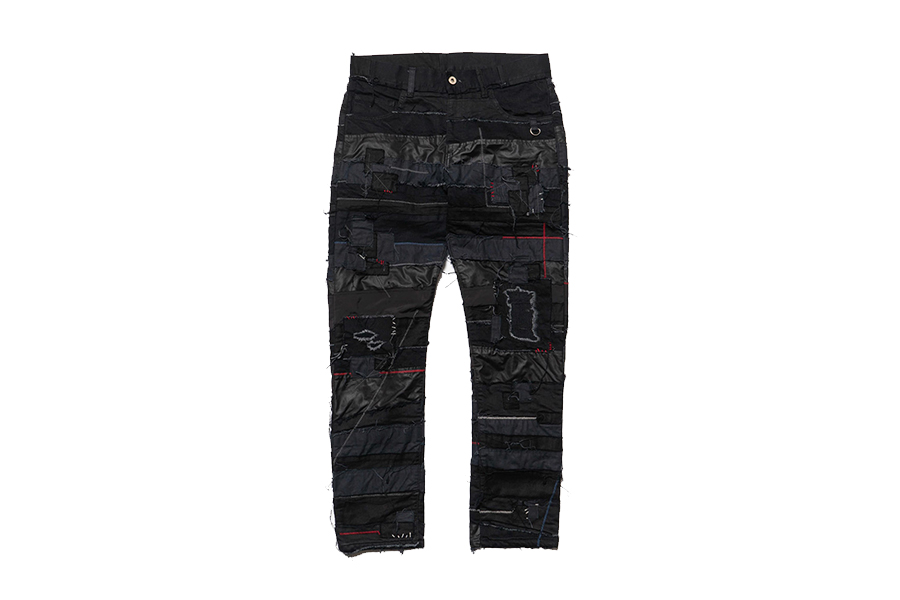
Crust punk fashion like its ethos focuses mainly on DIY and anti-capitalism, which means refusal of the consumption capitalism is founded on, leading to few garments, continuously repaired clothing, badges of political rebellion, and patches sewed on all types of clothes to reinforce weakened and damaged areas. Heavy layering, DIY accessories, distressed clothing, patched jackets and pants, are all tenets of crust punk fashion. Military clothing specifically is also a huge feature as well, as utility is key in a fashion of moderation and anti-capitalism. A fashion of sufficiency rather than excess. Anti-fashion. All these aspects work in synchronicity with their established value system.
Undercover SS03 “Scab” Collection
Ah, now we reach the crescendo of this article. Where the culmination of these features lay bare. Undercover SS03 Scab. The collection catapulted Jun Takahashi into the limelight and set the tone for some of his position in the world of “high fashion”. The term Scab loosely defines this collection, as its original meaning was “a dry, rough protective crust that forms over a cut or wound during healing”. A scab is a distortion, a natural response to the displacement of the body’s natural state. I interpreted the use of this term as a depiction of Undercover’s placement in the fashion industry. Jun was previously demotivated to present his work at fashion week with past encouragement being little to none, coupled with his anti-establishment philosophies, undercover was the result of a call for change.
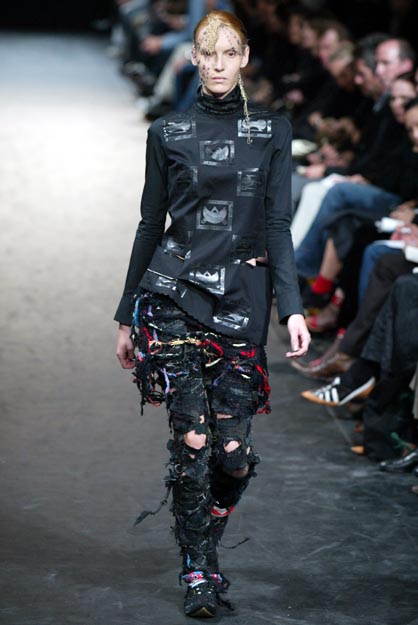
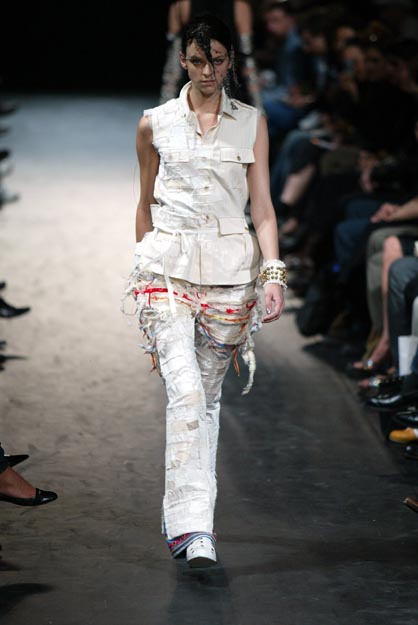
Set in Paris Fashion Week in 2002, the halls were littered with journalists, critiques and everyone in between at the behest of Rei Kawakubo, who earlier announced the debut of this collection and marked it as a must-see. On an unending stage enters a black hooded spirit strewn in patches from head to toe, loose threads and a rage took the platform, large strides as it covered the runway. It’s safe to say the audience was in a frenzy, some fearful, some perplexed, some disgusted, all attentive as the show left no time for distractions. Models in all black and all white took the stage, strolling back and forth covered in crust pants, full arm bangles, jewellery scattered across their outfits, loose threads and tattered clothing. It produced a mesmerizing effect. In this “refined” setting we saw glimpses of crust punk, the essential anti-thesis of all fashion week stood for. I say a glimpse because the core concepts of crust punk do not allow for the consumption this Fashion Week event suggested, and neither did it promote the conservative practices of high fashion. However, Jun Takahashi being a former member of the Tokyo Sex Pistols a punk rock band and a punk in practice did at least validate the intent behind the collection.
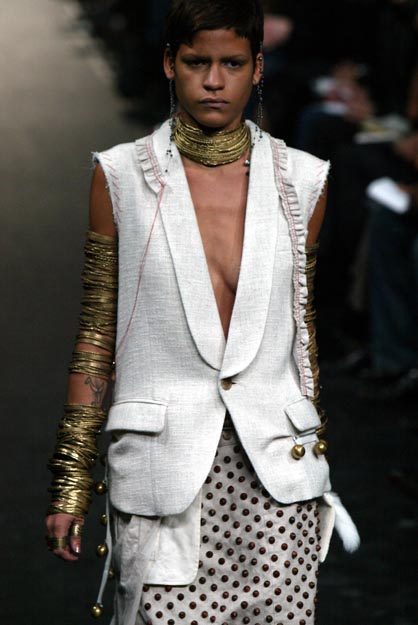
We saw braided hairstyles, loose beads, patches upon patches, and even unorthodox blazers, both reinforcing the punk identity and philosophies while slightly reinterpreting it in a more digestible manner for the audience. The more models passed, the more comfortable people grew with the ideas and visuals being laid before them. They could now appreciate the craftsmanship alongside the messages being communicated in this collection. Anarchy. Anti-Fashion. Anti-Capitalism. That is amongst other concepts, with the introduction of ethnic patterns from presumed indigenous and African groups we see an appreciation of culture during a period where anything deemed “foreign” to the West was perceived as unacceptable. Images embedded in both the invitation poster and garments on the runway of the crust punk band Sedition’s Earth Beat LP gave more credence to this, along with reinforcing Jun’s punk ties and his messages through this collection.
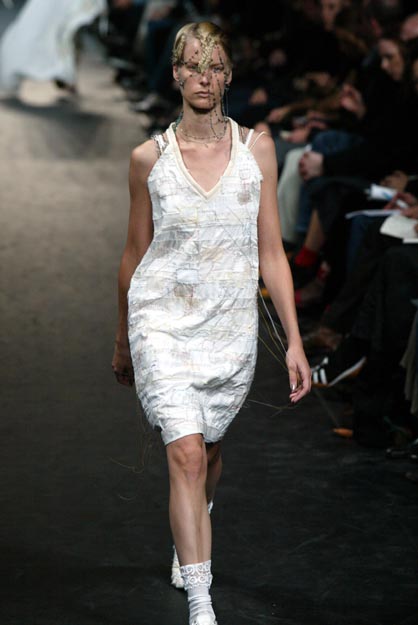
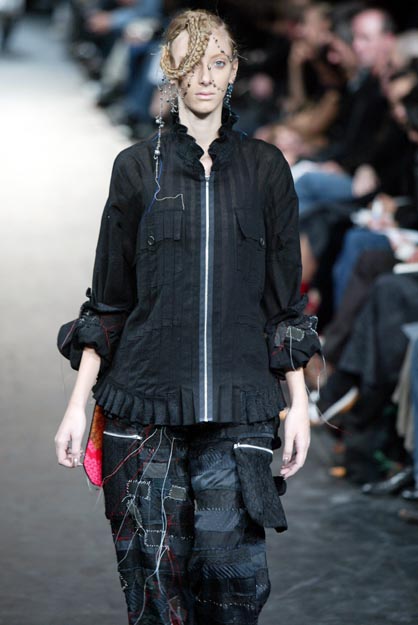
Pieces such as the crust punk blazers and vest, the crust punk blazer and the bell boots were some of my favourite garments from the collection. Formal pieces I wouldn’t be caught dead in outside of its specific design in this collection, aside from the boots of course. The full-arm bangles/bracelets were another favourite accessory, one I believe can be traced back to the Datooga ethnic group in Tanzania though this practice of arm jewellery can be seen across various ethnic groups and cultures.
I believe the most infamous moment of this show was the end where the lights went out, seemingly ending the show, only to light up again revealing models in burkas, not even a year out of the catastrophic 9/11 attacks. This candid display solidified Undercover’s moment in history.
Deconstructivist Perspective
My initial view of this collection was through the lens of deconstructivism which led me to write this article. Punk being at the forefront of this collection, it is inseparable from the culture itself. Deconstructivism and punk are largely different movements and ideologies, however, they possess similar traits. These traits are as such; anti-establishment philosophies, raw authenticity, DIY/experimentation, and Subverting the norm.
Anti-establishment philosophies: crust punk follows anarchist principles, employing a DIY mentality to oppose mainstream society and advocate for radical social and political change. Likewise, deconstructivism believes in defying the norms as they are inherently flawed and adopting creative approaches to achieve solutions.
Raw Authenticity: crust punk follows an ideology that abandons pre-established norms, this includes the concept of consumption, through this we see tattered clothing, haggard features and handmade accessories. In the same manner, deconstructivism adopting impure forms, more natural in their geometry can be said to pose the same raw authenticity.
DIY/Experimentation: rust punks advocate handmade clothing, worn in clothes, thrifting and etc, all aspects that require labour and creativity, those patches sewn, stitched, or glued onto the clothes for repair as evident in the undercover show are indicative of this trait. Similarly, Deconstructivist architects champion experimentation as it is the only true solution to the problem that is modern conservative architecture.Shadows of the same ghost.
Subverting the norm: crust punk rejects the socially accepted norms and champions new perspectives to existing beliefs, laws, and understandings. Deconstructivist architecture subverts traditional architectural principles and challenges conventional ideas about space, form, and function. In this way, both movements advocate critical thought while questioning established conventions.
Visually more than any other way I saw similarities between undercovers scab and deconstructivism. In applying patches, I saw the reconstruction of dismantled buildings deconstructivists create. The accessories along the faces and clothing were reminiscent of deconstructivists’ adoption of queer materials to distort our perception of form and space while conveying varied meanings depending on the application. The designs of the clothing and its fit on the human body mirror the remoulding of existing buildings by architects and its appearance, the fit being inhuman like the form of the building. Finally, the larger concept of rebuilding throughout the show and I believe one of its main themes as it relates to deconstructivism, we see these clothes possessing the style of upcycling/reparation, the appearance of tattered clothing with holes and loose thread juxtaposed its essence of strength and reinforcement, as these garments were stronger than ever yet their appearance gave birth to paradox, this representing the act of undercover as a brand and its reconstruction of the fashion industry.


 Zeros Domain
Leave a comment